
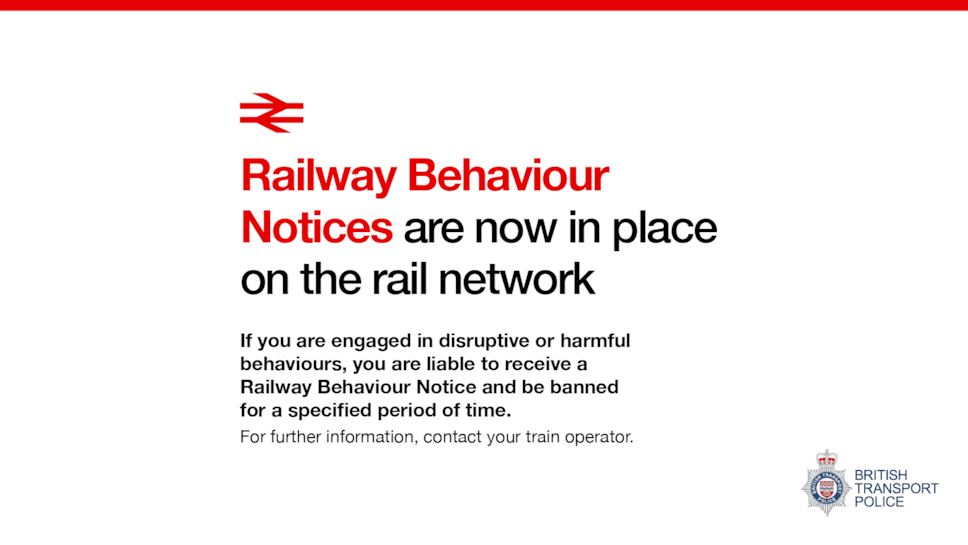
Railway acts to protect passengers and staff with new powers to ban repeat offenders
- Passengers and frontline rail staff are set to receive more protection from persistent antisocial behaviour at train stations across the rail network, as early trials show encouraging results.
Railway Behaviour Notices banning repeat offenders from stations are being rolled out across the rail network this summer, as a new early intervention measure to improve passenger and staff safety.
Backed by overwhelming public support, more than eight in ten passengers say they want people who abuse staff or other passengers to face railway bans.
The notices, aimed at dissuading repeat offenders from accessing railway stations, can be issued by train operators or British Transport Police to individuals who repeatedly put others at risk. They remove a person’s permission to enter a specific station or station(s) for six to twelve months, acting as a first line of defence to stop harmful behaviour before it escalates into formal criminal proceedings.
Early trials show a clear reduction in repeat offending, with frontline rail staff reporting safer working conditions.
In nationally representative polling of more than 2,000 frequent rail passengers:
- 86% support the rollout of Railway Behaviour Notices, with nearly 80% of rail users reporting that stronger action against abusive behaviour would make them more confident when travelling.
- Railway Behaviour Notices were ranked by passengers as one of the top three most effective safety measures, following increased visibility of British Transport Police and stronger penalties for abusive or aggressive behaviour.
The railway remains a safe place to travel with antisocial behaviour taking place on 1 in 80,000 passenger journeys, and serious violence offences account for 1 in a million passenger journeys made each year. The rail industry is not complacent and is committed to showing the small number of perpetrators that they are not welcome on the railways.
Jacqueline Starr, Executive Chair and Chief Executive Officer of Rail Delivery Group, said: “Railway Behaviour Notices help create immediately safer conditions for customers and frontline colleagues by banning individuals from the network who have shown they cannot use the railway responsibly.
“In this shared public space, the vast majority of passengers do behave responsibly, and this is about protecting their right, and the right of staff, to travel and work in safety.
“Crucially, they help stop harmful behaviour early, preventing situations from escalating to the point of formal criminal proceedings.
“This is a major moment for the railway. Early trials have already shown a significant reduction in repeat incidents, giving passengers and rail staff a safer environment and better working conditions for frontline staff. Because whether you work for or travel via rail, there is no place for crime or abuse on our network.”
Rail Minister Lord Peter Hendy said: “Everyone deserves to feel safe when they travel, and nobody should have to tolerate abuse or antisocial behaviour on our railways.
“These notices give operators and police a practical tool to stop repeat offenders sooner, before situations escalate - helping ensure everyone can travel with confidence and making clear that there is no place for abuse on our railways.”
Scott Brightwell, Safety, Planning and Performance Director at South Eastern Railway, said: “The overwhelming majority of people who use our railway do so respectfully. We will carry more than 138 million journeys this year, with customer satisfaction at 87%, and we will always take firm action against the small minority whose behaviour affects others.
“In the last 12 months, 105 individuals have been formally warned or banned from our network, sending a clear message that abuse and antisocial behaviour will not be tolerated.
“Railway Behaviour Notices give us an early way to tackle repeat offending and are just one of a range of measures we use, alongside visible enforcement and close partnership working with the British Transport Police and partners, so customers can continue to travel with confidence.”
BTP Assistant Chief Constable Ian Drummond-Smith said: “Railway Behaviour Notices give train operators stronger powers to tackle repeat anti-social behaviour, helping stop crime in its tracks before it happens. We’re committed to working closely with our rail industry partners when these notices are issued.
“Every rail passenger has the right to a safe journey, and millions are made across Britain every day without incident. However, on the rare occasions that an incident occurs, we will always support rail staff and take robust action.
“Anyone who experiences or witnesses an offence on the railway is urged to report it to us by texting 61016, or by calling 999 in an emergency.”
Working to curb persistent abuse, assault, harassment and disorderly behaviour at local stations, a warning letter followed by a railway Behaviour Notice can be issued to persistent troublemakers by train operators or Network Rail, which manage rail stations. For more serious incidents, a Behaviour Notice can be issued straight away.
For this purpose, the notices are proving to be an effective tool in addressing the issue of repeat offenders. In several cases, train operators have noted a marked reduction in incidents involving individuals who have received a Behaviour Notice, leading to improved working conditions for frontline staff and a safer environment for customers.
The challenge posed by antisocial behaviour is not unique to rail. In the Crime Survey for England and Wales more than a third of respondents (39%) said they personally witnessed or experienced antisocial behaviour in their area. Other frontline sectors such as hospitality and sports venues face similar issues. Despite the small number of individuals on the rail network who put others at risk, the rail industry is taking every available action to protect people from violence, harassment and intimidation.
Contact Information
Ione Gyamfi
Notes to editors
Notes to Editors
- Railway Behaviour Notices can last between six and twelve months and can be renewed if behaviour continues. Safeguarding remains central, with exemptions available for essential travel such as medical appointments or education.
- Drawing on the existing legal power to withdraw implied permission to enter railway premises, underpinned by railway byelaws and specific legislation, new rail industry guidance sets out the powers train operators have to tackle repeat antisocial behaviour.
- In a nationally representative survey of more than 2,000 frequent rail passengers, 86% support banning people who verbally or physically assault staff or other rail passengers from using the railway.
- Crime Survey for England and Wales (CSEW) data for year ending December 2025 shows that more than a third of respondents (39%) personally witnessed or experienced antisocial behaviour in their area.
- In 2024/25 there were 3.07 billion passenger journeys. BTP figures show:
- o There were 40,034 Antisocial behaviour incidents representing 1 in 80,000 passenger journeys.
- o There were 3,813 serious violence offences recorded, representing 1 in a million passenger journeys.
- o Sources: Lennon data and TfL data, BTPA Annual Report 2025.
- Train operators are taking a collaborative approach, working closely with the British Transport Police and community-based teams such as local authorities, local Home Office police forces.
- Where safeguarding is appropriate to determine the suitability of a Behaviour Notice or explore alternatives, specialist rail teams consult with local authorities, Mental Health Trusts, and other local support services.
- Employing railway byelaws, and other existing pieces of legislation, individuals who breach an active Railway Behaviour Notice risk arrest for trespass. The rail industry is encouraging passengers to report incidents by speaking to staff or texting British Transport Police on 61016 so that action can be taken.
- The Rail Delivery Group’s Zero Tolerance campaign provides clear guidance and practical tips on how bystanders can safely intervene if they witness harassment or assault. Using an immersive Virtual Reality (VR) film shown at stations across the UK, it provides passengers an opportunity to experience how situations can develop and what actions any travellers can take to de-escalate the situation in the moment.
- In Spring 2025, the Rail Delivery Group launched a campaign using real-life case studies to highlight the abuse faced by frontline staff. The campaign’s graphics and posters showed the frequency and severity of this behaviour, while also emphasising the consequences for offenders, including fines, bans and prison sentences.
- Whether witnessing or experiencing anything that makes you uncomfortable, we urge everyone to report incidents promptly to the British Transport Police via text at 61016.