
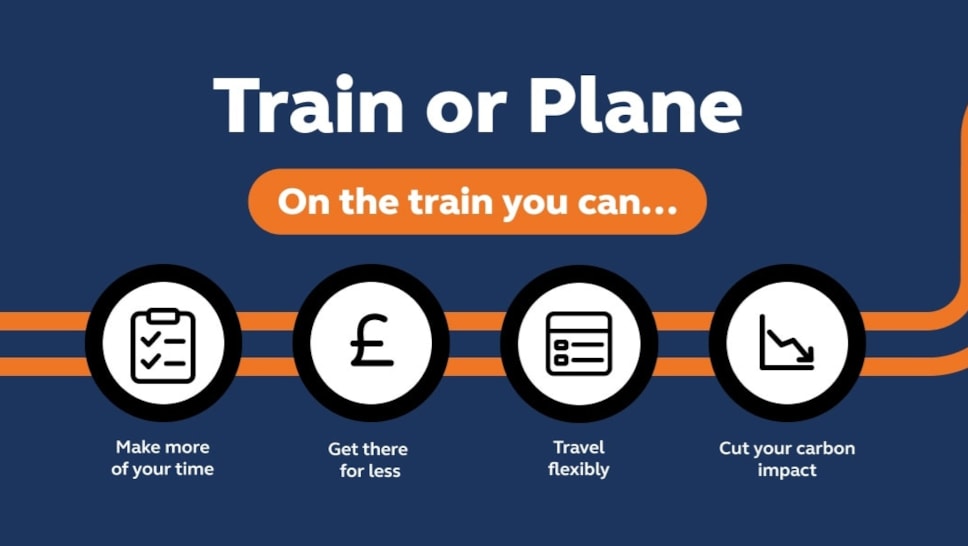
Why take the plane? New independent research reveals that train travel gives you more time to use, is quicker and cheaper than flying
- Rail passengers save 71% on average once the full cost of flying, including transfers, baggage and airport charges, is factored in, a saving of £147 per journey.
- Rail passengers gain an average of 3 hours more productive time per journey than those flying;
- Rail produces 85% less CO₂ per passenger - a saving of 102kg CO2e per passenger which is the equivalent of boiling 20,439 cups of water compared with travelling by air;
- London – Edinburgh: the full cost of flying is almost three times that of rail (£64 vs £202), with 45 rail services a day compared with 29 flights
New independent research published today challenges the long-held assumption that flying is the obvious choice for long-distance domestic travel in Great Britain. In fact, rail journeys are often cheaper, more productive and significantly greener than flying with 60% of people from an additional recent survey saying they would consider travelling by train rather than flying.
The ‘Clearing the Air’ report, published by transport consultancy Steer and commissioned by Rail Delivery Group, compares rail and domestic air travel across seven key long-distance routes in Great Britain. The analysis found that rail journeys are, on average, 71% cheaper than flying, produce 85% less carbon emissions, and provide passengers with around three hours more usable time per journey.
When looking at the cost element, researchers compared rail fare data from the rail industry’s Latest Earnings Networked Nationally Overnight (LENNON) system with air fare data from the Official Airline Guide (OAG). The fare analysis is based on demand-weighted average fares paid across all ticket types and travel classes in 2025, providing a more representative reflection of actual passenger spending than individual advertised fares. When the full cost of flying is taken into account, including airport transfers, baggage and seat selection fees, passengers saved an average of £147 per journey by choosing rail over air.
On the London–Edinburgh route, for example, a rail passenger pays an average of £64, while the true cost of the equivalent flight, once transfers and extras are added, comes to around £202 – almost three times as much.
However, despite these savings, a new poll of 2,000 adults found many people overestimate the cost of train travel. For example, when asked to estimate the cost between London and Edinburgh, people expected to pay on average £104, however the actual data revealed that taking the train is £40 cheaper than people expect with an average price of £64.
Passengers could also be out on quicker journeys on some of the most popular domestic routes. According to the polling, people estimate that trains take around an hour longer than flying, but the report data shows that passengers travelling between London and Newcastle can actually save an hour on average by travelling by train. For a business traveller making the London–Newcastle journey once a week, that adds up to the equivalent of a full working day every month.
On average, an estimated 93% of a rail journey can be spent working, reading, relaxing or staying connected, compared with 33% of a domestic flight journey once travel to the airport, check-in, security and boarding time are taken into account.
As a result, passengers travelling by train gain an average of three hours more usable time per journey than those who fly.
Rail travel also gives passengers more flexibility. On the London–Edinburgh route, there are 45 rail services a day compared with 29 flights. Whether plans change, a connection is missed, or simply wanting more choice over when you travel, rail offers more frequent services through the day.
Jacqueline Starr, Executive Chair and Chief Executive Officer at Rail Delivery Group said: “This research highlights the benefits rail can offer passengers, from lower costs and lower carbon emissions to more time that can be spent relaxing or staying productive.
“With frequent services connecting cities across Britain, rail offers a convenient, flexible and attractive way to travel”.
Rail travel also offers a more convenient and less stressful travel experience than flying. With no airport check-in, security queues or concerns about baggage restrictions, rail offers simpler and more seamless journeys from start to finish. This perception is reflected in the rail industry’s General Public Tracker, which found that the most commonly cited reason for choosing rail over other modes of transport was that it is relaxing and stress-free (33%).
Passengers also cited the scenic nature of rail journeys and the environmental benefits of travelling by train. Travelling by rail produces 85% less CO₂ per passenger than an equivalent domestic flight, with an average saving of 102 kg of carbon emissions per journey. Based on the seven journeys provided, this is the equivalent of boiling 20,439 cups of 250ml water compared with travelling by air. As more people look for ways to travel more sustainably, choosing rail over air is one of the simplest ways to make a difference.
VisitEngland Director Andrew Stokes added: “There’s something special about visiting the tourism treasures of our nations and regions by train.
“Whether it’s a cultural city break, a jet setting stay or a trip to one of our picturesque coastal or rural destinations, travelling by rail offers an easy, efficient and environmentally friendly way to explore more and enjoy spectacular scenery along the way.”
The research also comes as the Government rolls out its Great British Summer Savings scheme, with a temporary VAT reduction on eligible family attractions and days out helping households get more value from leisure trips across Great Britain this summer.
Contact Information
Rail Delivery Group Media Team
Notes to editors
- ‘Clearing the Air’ was produced by Steer (steergroup.com) and commissioned by Rail Delivery Group. The report covers seven domestic routes: London–Glasgow, London–Manchester, London–Edinburgh, London–Newcastle, Aberdeen–Manchester, Edinburgh–Exeter, and Bristol–Edinburgh.
- Full data and the report can be found here http://www.raildeliverygroup.com/trainvsplane
- Fare comparisons are based on average fares paid (2025 data), sourced from LENNON (rail) and OAG (air). Full-cost comparisons additionally include baggage, seat selection and airport transfer charges for air, reflecting the realistic total cost of each journey. Productivity estimates are based on the proportion of total journey time spent in-vehicle. Rail: 93% on average. Air: 33% on average, reflecting CAA-recommended 2-hour airport dwell time.
- Carbon figures are per passenger. Rail CO₂ sourced from Network Rail / industry data. Air CO₂ sourced from ICAO.
- Full methodology and technical annex available on request.
- Polling data was commissioned by Rail Delivery Group and completed by Censuswide. Nationally representative survey of 2,000 UK adults. Data collected between 10 June 2026 – 12 June 2026. Main results are:
- 60% of people are more likely to consider travelling by train than by plane on city-to-city journeys
- 37% think the train is more reliable for longer domestic journeys
- 54% think the train offers more choice and flexibility for longer domestic journeys
- Rail Delivery Group works with Britain’s train operators to deliver services for millions of passengers and businesses every day. www.raildeliverygroup.com